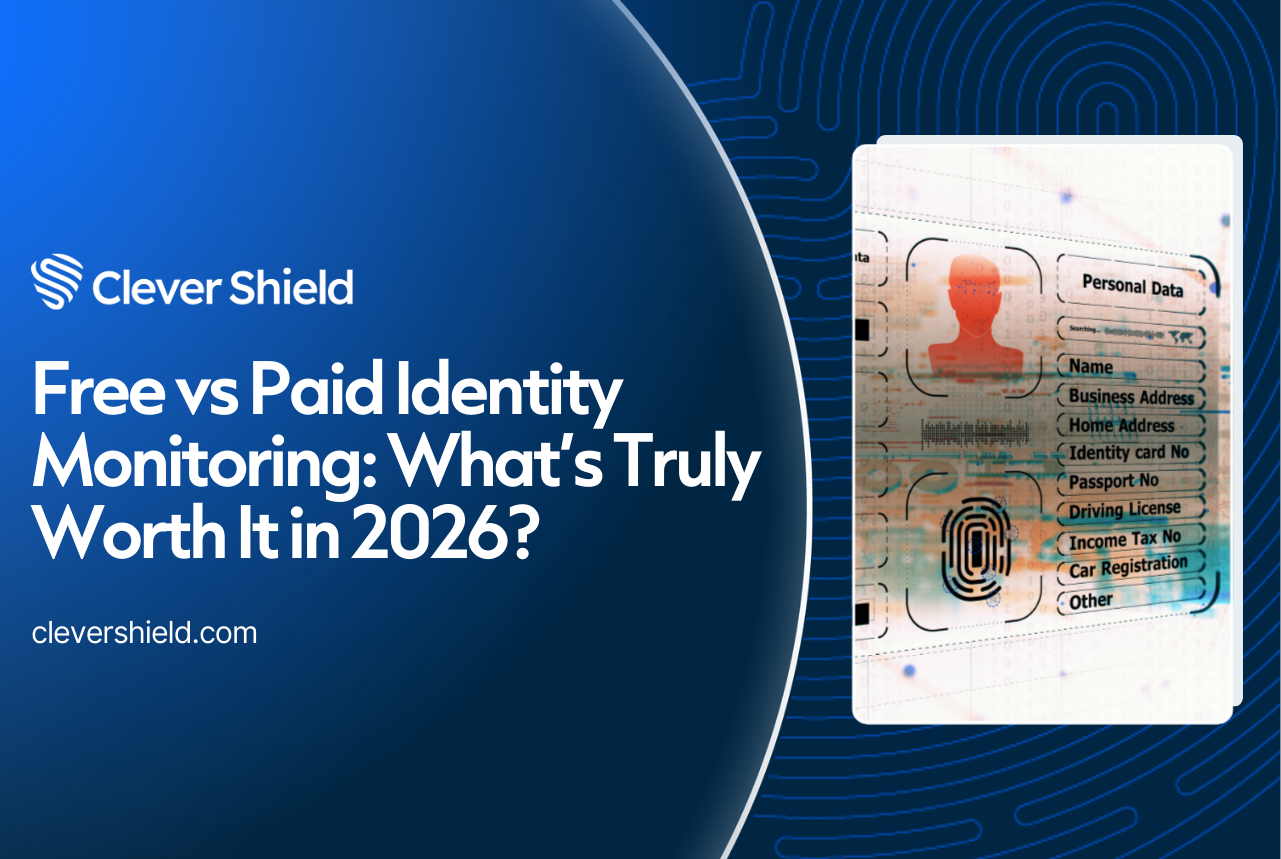
Identity theft is evolving faster than ever. With AI-generated scams, stolen credentials circulating across hundreds of platforms, and data brokers expanding aggressively, the real question isn’t whether you need identity protection — it’s whether free tools are enough in 2026.
The short answer: free tools help, but they don’t cover even half of the modern attack surface. To understand why, you first need to know what free identity monitoring actually tracks — and what it completely misses.
This breakdown compares the best free protections available today with what paid identity monitoring covers, and how Clever Shield closes the gaps that free solutions can’t.
What Free Identity Monitoring Actually Covers
When people search for free identity monitoring, they’re usually referring to tools that offer:
- Credit freezes
- Basic breach alerts
- Credit report access
- One-time dark web email checks
- Alerts from banks or credit card companies
These free protections are helpful — but extremely limited. They do not account for how criminals operate in 2026, and they often detect fraud only after the damage has started.
Let’s break down the biggest free tools and what they actually do.
1. Credit Freezes (Strong, But Narrow)
A credit freeze is one of the best free protections available. It prevents new accounts from being opened in your name, which blocks:
- Loan fraud
- Credit card applications
- Retail financing fraud
You can place a freeze for free with the three major credit bureaus. For reference:
But freezes do nothing to stop:
- Tax fraud
- Medical identity theft
- Account takeovers
- SIM swapping
- Dark web exposure
- Data broker circulation
Freezes only protect one slice of your identity — financial applications. Everything else remains exposed.
2. Free Breach Alerts (Useful But Outdated)
Many people rely on free breach notification tools. These tools alert you when your email appears in a past data breach. While helpful, they suffer from major limitations:
- Only detect old breaches, not active criminal use
- Only scan known databases
- Do not track repeated exposure or republishing
- Do not monitor full identity data (SSN, phone, drivers license)
The Federal Trade Commission recommends treating breach alerts as first warnings, not full protection — because breach data often spreads for months before criminals take action, and free tools simply don’t monitor that activity.
3. Free Credit Reports (Good for Spot Checks, Not Monitoring)
Through the official Annual Credit Report portal, you can check your credit reports for free. This helps reveal:
- New accounts
- Hard inquiries
- Incorrect addresses
- Collection accounts
But free reporting is still reactive — you only catch fraud after it has happened.
And criminals rarely begin with credit fraud anymore. They start by collecting small identity fragments from data brokers, social media, or dark web markets — long before anything appears on a credit report.
4. Bank Alerts (Too Slow for Modern Scams)
Banks offer free alerts for unusual transactions or logins. While useful, they do not monitor:
- Your SSN
- Your digital footprint
- Your dark web exposure
- Your public records
- Your identity data circulating online
By the time a bank detects fraud, thieves are often several steps ahead, especially in 2026 where AI-powered scams can mimic your voice, location, or behavior.
Where Free Identity Monitoring Completely Fails
Here’s the uncomfortable truth: free tools focus only on post-incident detection. They alert you when something is already wrong — not before.
To understand why free monitoring isn’t enough, consider what modern attacks involve:
- Data brokers republishing your info every 48 hours
- AI-generated deepfake phone scams using your voice
- Stolen SSNs sold in bulk on dark web forums
- SIM-based identity theft bypassing SMS 2FA
- Credential stuffing attacks using breached passwords
- Tax return fraud filed before January even ends
No free tool covers these.
The Advantage of Paid Identity Monitoring in 2026
Paid monitoring solutions track significantly more data sources and threat surfaces than free tools ever will. Here’s what paid monitoring typically adds:
✔ Real-Time Alerts Instead of Delayed Notifications
Free tools batch their alerts. Paid monitoring identifies threats instantly, which is crucial for:
- Account takeovers
- Dark web exposure
- SSN misuse
- Phone-number based fraud
✔ Full Identity Footprint Monitoring
This includes:
- SSN
- Emails
- Phone numbers
- Driver’s license
- Bank account metadata
- Public records
- Home and mailing address changes
✔ Monitoring of Criminal Marketplaces
Paid monitoring scans for signs that your identity is being traded, bundled, or weaponized — something free tools simply don’t detect.
✔ Identity Restoration Support
Free tools give you alerts. Paid services actually fix the problem, including:
- Fraud disputes
- Affidavits
- Account recovery steps
- Removing incorrect entries
- Coordinating with credit bureaus
Restoration alone can save users dozens of hours — especially after a major breach.
What Paid Monitoring Usually Still Gets Wrong
Even many paid services are outdated. Most do not remove your data from brokers, and many send alerts too late because they rely on outdated scanning methods.
That’s where Clever Shield is different.
How Clever Shield Fills the Gaps Free Tools Cannot Cover
Clever Shield isn’t just monitoring — it’s prevention, action, and restoration.
⭐ Automated Data Broker Removals
Free tools don’t touch data brokers at all. Clever Shield removes your data from hundreds of broker sites — and keeps it removed.
⭐ Real-Time AI-Driven Monitoring
Clever Shield monitors:
- Dark web exposure
- SSN misuse attempts
- Phone-number based fraud signals
- Address and public record changes
⭐ Full Identity Restoration
Free tools leave you alone with the problem. Clever Shield assigns specialists who fix the issue end-to-end.
⭐ $1 Million Identity Theft Insurance
Because financial losses today can be devastating, insurance is now essential — and included.
The Bottom Line: Free vs Paid Identity Monitoring
You should absolutely use free protections. They help — but only up to a point.
The truth is simple:
Free identity monitoring protects part of your identity. Paid monitoring protects the whole thing.
If you want to know how exposed you already are, you can run a free scan with Clever Shield in under 60 seconds.